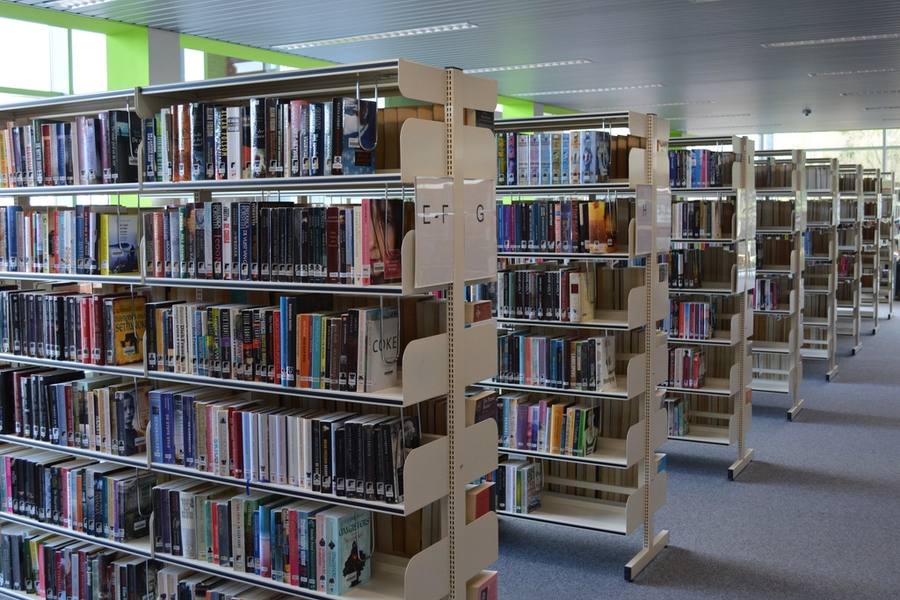
Representative image (stock photo); not the exact product.
Books Are Far Heavier Than People Estimate
A metre of packed hardbacks weighs a considerable amount, and a shelving unit rated for decorative objects will sag or fail entirely under a full row of books.
Load rating per shelf is the specification that matters, and it is frequently absent from product descriptions for furniture not specifically intended for books.
That absence is itself informative, and anything sold as a display unit rather than a bookcase should be assumed inadequate for a full load of books.
Shelves Sag Over Time
A shelf supported only at its ends bows downward under sustained load, and that sag is permanent once it has developed even if the books are removed.
Shelf span is the critical factor, and a shorter span between supports resists sagging far better than a long one of the same material and thickness.
Thicker shelves, a supporting rail along the back edge, or a central divider all address it, and anything wider than about eighty centimetres without support will eventually bow.
Adjustable Heights Recover Wasted Space
Books vary enormously in height, and a shelf spaced for large volumes leaves considerable empty air above paperbacks.
Adjustable shelves let each shelf be set to the books it holds, which recovers a substantial proportion of a bookcase's volume across a full unit.
Fixed-height units waste that space permanently, and over a whole bookcase the difference is frequently a shelf's worth of additional capacity.
Depth And Double Stacking
Deep shelves allow books to be stored two rows deep, which doubles capacity and makes the back row effectively invisible and inaccessible.
That suits archival storage and is poor for books actually being read, and a shallower shelf that holds one row keeps everything visible.
Standard paperback depth is considerably less than hardback depth, and a shelf sized for paperbacks will not take larger books at all.
Securing It To The Wall
A tall bookcase loaded unevenly, particularly with heavy books high up, can tip forward, and this has caused serious injuries and deaths involving children.
Wall fixing brackets are supplied with most units and should be used, which is a genuine safety matter rather than a precaution.
Loading heavy books low and lighter ones high also lowers the centre of gravity considerably, and it costs nothing to do.
Assembly quality is worth a moment of thought since most bookcases arrive flat-packed and their strength depends entirely on being assembled square and fully tightened. A cabinet assembled slightly out of square racks under load and the shelves then sit at an angle, which accelerates sagging and looks wrong permanently. The thin hardboard back panel that most people regard as cosmetic is in fact what holds the unit square, and leaving it off or nailing it on loosely is a common and consequential shortcut.
Particle board and solid wood behave very differently under sustained load, and most affordable shelving is the former with a veneer. Particle board sags considerably sooner and, once it has, cannot be straightened at all, where solid timber of the same thickness holds far longer.
The Verdict
The right storage for books where load rating, shelf span and adjustability determine whether a unit works over years.
Sagging is permanent, deep shelves hide a back row, and an unsecured tall bookcase is a genuine hazard.
Fix it to the wall. A loaded bookcase tipping forward has caused deaths, and the bracket comes in the box.
At a glance
Pros
- Adjustable shelves recover wasted vertical space
- Short spans resist the sagging that ruins shelves
- Depth options suit paperbacks or hardbacks
- Wall brackets are usually supplied
Cons
- Sagging is permanent once it develops
- Deep shelves hide and block a back row
- Display units are rarely rated for book loads
- Tall unsecured units are a genuine tipping hazard
Frequently asked questions
Why is my shelf bowing?
Books are far heavier than people estimate and a shelf supported only at its ends bows under sustained load. That sag is permanent even once books are removed. Shorter spans, thicker shelves or a central divider prevent it.
Why bother with adjustable shelves?
Books vary enormously in height, and a shelf spaced for large volumes leaves considerable empty air above paperbacks. Across a whole unit, adjustability frequently recovers a shelf's worth of additional capacity.
Do I need to fix it to the wall?
Yes. A tall bookcase loaded with heavy books high up can tip forward, and this has caused serious injuries and deaths involving children. The bracket is usually supplied and using it is a genuine safety matter.
Specifications
| Type | Adjustable shelf bookcase |
| Critical specification | Load rating per shelf |
| Sagging factor | Shelf span between supports |
| Span limit | Around 80 cm without support |
| Adjustability | Recovers space wasted above short books |
| Depth | Match to paperback or hardback |
| Safety | Wall fixing bracket, always used |
| Loading | Heavy books low, light books high |
The bottom line
Check the load rating and the span. And fix it to the wall — tipping bookcases have killed children.
Check Price on Amazon